

Your chimney stands as the most exposed element of your Markham home, bearing the brunt of intense summer heat, driving autumnal rain, and punishing winter storms. Over time, external brickwork and mortar joints undergo unrelenting stress from natural weather patterns and thermal shifts. When masonry joints weaken or individual bricks crack, moisture readily penetrates behind your home exterior envelope, leading to progressive internal decay, degraded draught efficiency, and compromised structural integrity. Markham Chimney Services, located at 4418 Highway 7 East, provides dedicated chimney masonry solutions crafted specifically to shield local residential properties against harsh climate damage while maintaining the architectural beauty of your neighbourhood.
Neglecting masonry issues rarely results in simple cosmetic flaws; moisture that enters small gaps invariably travels downward into living spaces, attic insulation, and firebox assemblies. Serving neighbourhoods across Markham and communities throughout the Greater Toronto Area (GTA), our team brings practical problem-solving directly to your doorstep. We take great pride in restoring structural stability using proven trade techniques, time-tested mortar formulations, and meticulous attention to detail. Whether you have noticed loose bricks, crumbling sandy mortar, or mysterious interior damp patches, professional masonry intervention stops progressive decay before simple preventative restorations transform into urgent, costly full-scale rebuilds.
Chimney Masonry Services: visit summary
Chimney Masonry Services in Markham: cracked brick, loose mortar and weather damage assessed and repaired before water gets in. Serving Markham and the Greater Toronto Area (GTA). The estimated local market range is $450 – $3,800, not a fixed company rate. The final scope and quote are confirmed before work begins.
| Estimated market range | $450 – $3,800. All estimates are in Canadian dollars and exclude 13% Ontario HST. |
|---|---|
| Typical time | 1 to 3 days depending on accessibility, height, and rebuilding scope |
| Price factors | Total height, roof pitch, and accessibility of the chimney stack; Extent of structural deterioration requiring repointing versus rebuilding; Condition of terminal concrete crown and integrated roof flashings |
| Routine signs to discuss | Spalling and Flaking Brickwork; Crumbling or Eroded Mortar; White Powdery Efflorescence; Cracked or Sunken Chimney Crown; Leaning or Tilted Stack; Interior Ceiling and Wall Stains |
Understanding Residential Chimney Masonry and Anatomy
A residential chimney is far more than an upright stack of decorative clay bricks. It functions as a complete venting structure engineered to exhaust harmful combustion by-products safely away from your living quarters while withstanding heavy environmental exposure. The primary assembly consists of an exterior brick or stone wythe, internal flue liners, joint bonding material, a top concrete wash or crown, and protective lead or copper flashings at the roof junction. Every component must work in absolute harmony to resist gravitational load, wind uplift, thermal shock, and exterior moisture penetration throughout all seasons.
The external masonry serves as the primary barrier protecting the delicate interior venting passages from outdoor elements. When builders construct traditional masonry chimneys, they rely on carefully balanced mortar beds to distribute structural loads evenly across the brick courses. Because mortar is deliberately formulated to be slightly softer and more vapour-permeable than the surrounding clay bricks, it acts as a sacrificial layer that absorbs subtle building movement and moisture fluctuations. Understanding this relationship helps homeowners realise why regular mortar joint care is essential for safeguarding the entire stack over several decades.
Inside the chimney structure, flue tiles safely convey hot gases, smoke, and moisture away from wood-burning fireplaces or high-efficiency heating equipment. If outer brick walls sustain damage or begin leaning due to footing settlement or water intrusion, the inner lining materials often shift out of alignment or crack internally. This mechanical strain can allow corrosive moisture and volatile exhaust fumes to seep directly into adjacent framing. Maintaining strong exterior brickwork is the single best way to ensure the internal components remain dry, secure, and properly aligned for safe domestic heating.
- Exterior brick wythe supporting structural stability against wind loads
- Sacrificial mortar beds designed to cushion bricks and manage moisture
- Poured concrete chimney crown shedding surface water outward
- Base and step flashings forming watertight seals with roof shingles
- Internal clay tile or metal flue liners safely channelling flue gases
Durable brickwork, dependable repointing, and trusted weatherproofing for Markham homes.
Self-check
Warning signs you need chimney masonry services
Spalling and Flaking Brickwork
External brick surfaces pop, crack, or shed layers onto your roof, exposing softer inner clay cores to accelerated moisture damage and structural deterioration throughout wet winter conditions.
Crumbling or Eroded Mortar
Mortar joints between bricks turn powdery, wash away under heavy rainfall, or develop deep hollows that destabilise surrounding brick courses and permit direct water penetration into the structure.
White Powdery Efflorescence
Chalky mineral deposits coat the exterior brickwork, indicating that liquid water is actively migrating through the masonry wall assembly and leaving evaporated salts across the outer surfaces.
Cracked or Sunken Chimney Crown
The concrete surface capping your chimney exhibits visible fractures or settlement, allowing rain and melting snow to pour directly down into interior flue joints and structural wall cavities.
Leaning or Tilted Stack
The chimney visibly leans to one side or bows above the roofline, signalling severe structural compromise, footing settlement, or internal mortar washout that requires immediate structural evaluation.
Interior Ceiling and Wall Stains
Discoloured brown water stains or peeling paint appear on ceilings and drywall adjacent to the chimney breast, indicating failing roof flashings or completely saturated masonry courses above.
The Impact of Ontario Freeze-Thaw Cycles on Brickwork
The climate across Markham presents severe challenges for exterior masonry installations, primarily due to intense freeze-thaw cycles that occur throughout late autumn, winter, and early spring. Clay bricks and Portland-based mortars are naturally porous materials containing tiny microscopic capillaries. During wet autumn days, rain saturates these porous matrices. When temperatures drop below zero overnight, trapped moisture freezes and expands by approximately nine percent in volume, exerting tremendous hydraulic pressure against the internal structure of the masonry.
As day breaks and temperatures rise above freezing, the ice melts, allowing liquid water to travel even deeper into freshly widened fissures before refreezing the following night. This repetitive cycling leads to a destructive phenomenon known as spalling, where the hardened outer protective faces of individual bricks pop, flake, or crumble away completely. Once the vitrified exterior surface of a clay brick is lost, the softer interior core quickly disintegrates into dust, accelerating the breakdown of adjacent mortar beds and destabilising upper chimney courses.
Standard wall surfaces beneath roof eaves enjoy protection from heavy rain, but rooftop chimneys remain entirely exposed to horizontal winds and driving sleet without any shelter. In addition to sub-zero temperatures, the internal heat generated by active home heating appliances creates steep temperature gradients across chimney walls. This dramatic contrast between hot internal flue gases and freezing exterior air accelerates structural expansion and contraction, creating micro-fractures in aged mortar that make timely seasonal masonry repairs vital for Ontario homeowners.
- Hydraulic expansion pressure caused by trapped sub-surface moisture freezing
- Accelerated brick face spalling following repetitive autumn and winter cycles
- Thermal shock created by extreme temperature differences inside and outside
- Washout of degraded lime and cement binders under persistent rain and sleet
- Progressive destabilisation of upper chimney courses above the roofline
Essential Safety Considerations: Flue Gases and Carbon Monoxide
While masonry deterioration is frequently treated as an aesthetic nuisance, compromised structural brickwork directly affects household health and fire safety. A damaged chimney stack can develop hidden fissures that breach the boundary between the internal exhaust passage and your home attic or upper floor spaces. When flue walls leak, dangerous combustion products including carbon monoxide, nitrogen dioxide, and volatile organic compounds can drift into living areas rather than venting harmlessly above your rooftop.
Carbon monoxide is an invisible, colourless, and odourless gas that prevents red blood cells from transporting oxygen throughout the body. Even minor cracks in masonry joints that run adjacent to damaged flue tiles can permit slow, steady seepage of this toxic gas into adjacent bedrooms or ceiling cavities. Following established Canadian safety practices, every Markham household operating a fuel-burning appliance must maintain operational carbon monoxide alarms on every sleeping level, paired with regular visual examinations of chimney masonry.
Furthermore, deteriorating masonry can drop heavy debris directly down into the flue interior, creating partial or total blockages that prevent normal combustion draught. When soot, dislodged mortar fragments, or broken chimney crown pieces accumulate on smoke shelves or within venting pipes, heating equipment cannot draw fresh air efficiently. This restriction causes dangerous back-drafting, forcing smoke, toxic fumes, and unburnt hydrocarbons straight back down through fireplace openings and appliance joints into your living environment.
- Prevention of toxic carbon monoxide migration into living quarters and attics
- Maintenance of consistent updraught for clean, safe appliance combustion
- Elimination of internal flue blockages caused by falling brick or mortar debris
- Adherence to Canadian residential safety principles for fuel-burning fixtures
- Protection of combustible attic framing materials from escaping heat and embers
Evaluating Spalling Brickwork, Mortar Decay, and Flue Health
Evaluating a chimney requires careful observation of both subtle early indicators and blatant symptoms of structural distress. One of the earliest warning signs is efflorescence, visible as white powdery crystalline deposits coating the red brick surfaces. While efflorescence itself is harmless mineral salt left behind by evaporating water, its persistent presence proves that excessive moisture is travelling through the wall assembly, signalling that water penetration is actively occurring beneath the surface.
As deterioration advances, mortar joints begin showing signs of erosion, crumbling into sand-like grains when lightly scraped with a screwdriver or finger. Gaps appearing between mortar beds and bricks permit winds to push rain directly inside the structure, loosening the mechanical interlock that holds the chimney vertical. If left unaddressed, bricks may begin shifting out of plumb, producing a visible tilt or bow above the roofline that indicates significant foundation or internal structural decay.
Inside the residence, warning signs frequently appear on ceilings, attic rafters, or wallpaper adjacent to the chimney breast. Damp stains, peeling paint, musty odours, or white powdery mineral deposits on attic framing usually point to failing chimney flashings or saturated masonry above the roof deck. Promptly identifying these symptoms allows Markham homeowners to commission targeted repointing or partial rebuilding before water causes catastrophic damage to interior drywall, structural lumber, and ceiling joists.
- White mineral efflorescence indicating recurring internal moisture transit
- Recessed, sandy, or missing mortar joints between external brick courses
- Flaking, cracked, or entirely missing brick faces across upper chimney courses
- Chimney stacks visibly leaning, bowing, or shifting out of plumb
- Damp ceiling stains and musty odours developing along interior chimney breasts
"I scheduled a full fireplace cleaning before winter. They used professional-grade tools to remove every trace of soot, tested airflow, and provided clear advice on maintenance. My hearth looks brand new and works flawlessly."

Our process
How we handle your chimney masonry services, step by step
- 1
Detailed Visual Assessment
We examine the entire chimney stack from ground level, roofline, and attic space to identify joint erosion, spalling brick, crown deterioration, and flashing defects.
- 2
Site Protection and Preparation
Our crew establishes secure roof staging and places heavy protective tarps over shingles, gutters, and surrounding landscaping to ensure complete property protection during work.
- 3
Precision Joint Raking
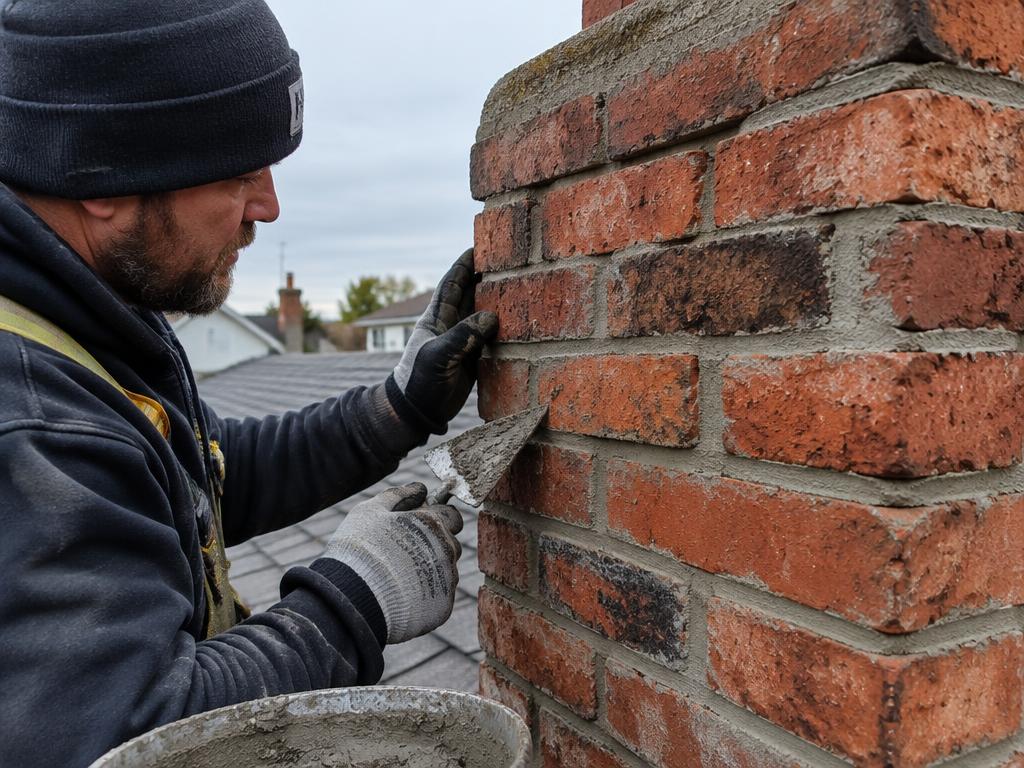
We grind out deteriorated mortar to a uniform depth using dust-controlled mechanical tools, removing all loose debris without nicking or fracturing adjacent brick edges.
- 4
Mortar Packing and Tooling
We prepare a custom-matched, breathable mortar mixture, firmly packing the open joints in layers before striking clean, water-shedding profiles that blend with existing brickwork.
- 5
Terminal Crown and Seal Application
Technicians repair or cast a durable concrete crown, service junction flashings, and apply a breathable penetrating water repellent to secure long-term weather resistance.
Professional Masonry Restoration: Repointing and Rebuilding
Restoring aged chimney brickwork requires specialised trade techniques that respect the original structural characteristics of the building. When the structural brick remains sound but the joint material has eroded, repointing stands as the primary restorative solution. Our technicians carefully grind out damaged mortar to a uniform depth using dust-controlled diamond cutting equipment, taking care never to strike or damage the surrounding brick edges during the preparatory removal phase.
Selecting the correct replacement mortar is critical for lasting success. Modern ultra-hard Portland cement mixtures must never be applied blindly to historic or softer residential bricks, as excessively rigid mortar prevents natural thermal expansion and will cause old bricks to crack under pressure. We carefully formulate replacement mortar mixes to match the compressive strength, breathability, and aesthetic tone of your original structure, packing the joints firmly in layers before striking a clean, water-shedding concave profile.
When brick decay extends deep into the core or the upper stack exhibits structural displacement, tuckpointing alone is insufficient and partial or complete rebuilding becomes necessary. In these situations, our team safely dismantles compromised masonry down to stable, undamaged courses. We clean sound existing surfaces, replace ruined units with colour-matched bricks, and reconstruct the chimney from the roof line upward using reinforced ties, fresh mortar beds, and a properly detailed terminal top to ensure decades of dependable performance.
- Precision mortar removal using dust-controlled mechanical grinding tools
- Custom-blended mortar formulations balanced for breathability and flexibility
- Firm hand-packing of fresh mortar beds to eliminate hidden internal air voids
- Careful joint tooling that promotes rapid rainwater runoff across walls
- Safe dismantling and structural rebuilding of leaning or unstable chimney tops
Chimney Crowns, Flashings, and Weatherproofing Defences
The very top of your chimney stack relies on the chimney crown to act as an umbrella for the entire vertical structure. Unfortunately, many homes were built with thin mortar washes rather than true, structural concrete crowns. Mortar washes shrink rapidly, developing hairline cracks that funnel rain straight downward into the inner core of the brick walls. A proper chimney crown must be cast using durable, fiber-reinforced concrete with a slight downward slope and an overhang that casts water away from the masonry.
Equally vital is the flashing system installed where your chimney penetrates the roof deck. This junction experiences continuous natural movement caused by building settling and roof deck expansion. Reliable weatherproofing requires a two-piece flashing system consisting of base flashing secured to the roof surface and counter-flashing embedded deeply into the chimney mortar joints. If flashings pull loose, corrode, or rely on cracked roofing tar, water runs freely along roof rafters and destroys ceiling drywall.
To provide a final layer of protection against the Markham climate, breathable siloxane or silane masonry water repellents can be applied to cured brickwork. Unlike silicone sealers or paint, which trap moisture inside the brick and cause rapid winter spalling, vapour-permeable water repellents penetrate deep into the substrate. They cause liquid rain to bead and roll away from exterior surfaces while allowing internal water vapour to escape harmlessly into the atmosphere.
- Reinforced concrete crowns engineered with water-shedding overhangs
- Drip edges underneath crowns preventing runoff from washing down brick faces
- Two-part step and counter-flashing systems tailored to roof pitch variations
- Elimination of brittle asphalt roofing cements in favour of flexible sealants
- Vapour-permeable siloxane water repellent applications that permit breathability

Homeowner Preventative Maintenance and Seasonal Upkeep
Markham homeowners can safeguard their investment by establishing simple seasonal monitoring routines. Twice every year, particularly during late spring after the winter thaw and in mid-autumn before the first deep freeze, take a pair of binoculars and inspect your chimney from multiple vantage points on the ground. Look closely for missing mortar, freshly chipped brick pieces lying in gutters, or plants taking root within decaying joints.
Keeping roof drainage pathways clear is another critical preventative step that directly protects your masonry. When roof gutters or downspouts become clogged with leaves, melting snow and stormwater can back up under shingles and splash continuously against the chimney base. Ensure downspouts direct water away from foundation walls, and keep overhanging tree branches pruned back so damp shade does not foster moss, lichen, and algae growth along chimney faces.
Pay equal attention to internal conditions throughout the heating season. Inspect your attic space periodically during heavy rains to check for dampness along the chimney framing, and verify that all household carbon monoxide detectors receive fresh batteries and regular functional tests. Pairing these easy visual checks with scheduled professional chimney inspections ensures that minor joint weathering is resolved early, keeping your home warm, dry, and safe.
- Bi-annual ground-level visual inspections using binoculars each spring and autumn
- Routine clearing of roof gutters to prevent overflow splashing at the chimney base
- Pruning tree branches to encourage sunlight exposure and reduce moss growth
- Periodic checks of attic spaces around the chimney stack after heavy rainfall
- Monthly testing of carbon monoxide alarms located across all living levels
Selecting a Qualified Masonry Contractor in Markham
Choosing the right contractor for your chimney masonry repairs is an important decision that impacts your property value, structural safety, and long-term peace of mind. Chimney restoration requires specific technical knowledge of high-heat environments, venting physics, and exterior building envelopes that general handymen often do not possess. When evaluating service providers, look for companies that demonstrate clear expertise in residential masonry restoration and follow recognized Canadian industry standards.
Always request a comprehensive written estimate that clearly details the scope of work, preparation methods, materials being supplied, and site cleanup procedures. Reputable masonry professionals will explain why a specific mortar blend was selected for your property, outline how they plan to protect your roof and landscaping during demolition, and provide clear proof of full commercial liability insurance and worker compensation coverage before commencing any work.
Be cautious of contractors who propose quick fixes, such as coating damaged brick with standard exterior house paint or slathering black tar over cracked concrete crowns. These shortcuts inevitably trap internal moisture and cause severe structural spalling within one or two winters. Partnering with a dedicated local independent service company, such as Markham Chimney Services at 4418 Highway 7 East, ensures your chimney receives durable craftsmanship tailored specifically to our local Ontario climate.
- Verification of comprehensive commercial liability insurance and worker safety coverage
- Detailed written quotes itemising materials, preparation, and joint tooling methods
- Proven expertise in matching mortar compressive strength to existing brick types
- Clear policies regarding site protection, debris disposal, and property cleanup
- Avoidance of superficial shortcuts like non-breathable paints or roofing tar patches
Average pricing in Markham
$450 – $3,800
- Inspection / diagnostic
- $150 – $250 visual roofline assessment fee, credited toward completed service
- Typical time on site
- 1 to 3 days depending on accessibility, height, and rebuilding scope
- Parts and materials
- Replacement clay bricks, custom mortar formulations, flashing metals, and concrete crowns quoted separately
- What moves the price
- Total height, roof pitch, and accessibility of the chimney stack · Extent of structural deterioration requiring repointing versus rebuilding · Condition of terminal concrete crown and integrated roof flashings
Estimated local market range, not a quote. All estimates are in Canadian dollars and exclude 13% Ontario HST. Your exact price is confirmed before any work begins.