
A Monessen gas fireplace provides an inviting focal point and dependable supplemental heat when winter settles across Markham. Whether your unit is a vent-free model, a direct vent insert, or a traditional gas log set, these heating appliances rely on balanced gas pressures, responsive electronic controls, and properly calibrated safety sensors. Over time, normal household dust, pet hair, and seasonal temperature shifts can lead to stubborn pilot lights, sooty burner ports, or intermittent heat loss. Markham Chimney Services operates from 4418 Highway 7 East to provide dedicated diagnostic evaluations, detailed cleanings, and component repairs for homeowners across Markham neighbourhoods seeking practical, neighbourhood-based fireplace support.
Because we are an independent chimney and fireplace service company, our advice remains completely impartial and focused on the longevity and safety of your specific appliance. We are not a factory outlet or affiliated directly with Monessen, which means our recommendations prioritize what is genuinely best for your household budget and home comfort. In our cold southern Ontario climate, sudden mid-winter breakdowns leave living rooms chilly and disrupt your family routines. We combine careful mechanical assessments with proactive maintenance practices that follow Canadian safety standards, helping your gas hearth operate cleanly, reliably, and safely throughout the harshest months of the heating season.
Monessen Hearth Fireplace: visit summary
Monessen Hearth Fireplace: glass, burners, pilots and controls cleaned and serviced, then relit and flame-checked. Serving Markham and the Greater Toronto Area (GTA). The estimated local market range is $229 – $489, not a fixed company rate. The final scope and quote are confirmed before work begins.
| Estimated market range | $229 – $489. All estimates are in Canadian dollars and exclude 13% Ontario HST. |
|---|---|
| Typical time | 1 to 2 hours typical on site |
| Price factors | Whether the issue requires standard maintenance or specialized electrical and valve replacement; Physical accessibility of the fireplace venting, direct vent termination, and cabinet cavity; Extent of carbon soot buildup and age of existing internal components |
| Routine signs to discuss | Pilot Won't Stay Lit; Delayed Main Ignition; Soot on Glass or Logs; Persistent Strange Odours; Sluggish or Noisy Fan; Unresponsive Remote Control |
Understanding Monessen Hearth Systems and Independent Service
Monessen hearth appliances are known for their versatile designs, spanning direct-vent units, gas log sets, and vent-free burner systems that deliver efficient radiant and convective heat. Inside every Monessen assembly, an intricate balance of gas valves, thermocouples, thermopiles, or electronic intermittent pilot ignition modules works together to ensure smooth operation. When you turn on your wall switch or handheld remote, the system must confirm a safe flame presence before opening the main valve to distribute fuel across the burner tray.
As an independent service provider, Markham Chimney Services brings dedicated technical insight to troubleshooting and maintaining these appliances without retail sales pressure. We source compatible replacement parts through trusted commercial suppliers and approach every service visit with a focus on mechanical integrity. Our goal is to extend the operating life of your existing unit, clean away accumulated debris, and verify that all combustion and venting dynamics perform precisely as intended by the original equipment design.
Understanding how your Monessen fireplace fits into your living room environment also requires looking at local living conditions. High-rise residences along the Highway 7 corridor often experience unique pressure differentials, while single-family detached homes in Unionville, Langstaff, or Milliken contend with varying basement drafts and exterior wind loads. Our independent maintenance focuses on the real-world operation of your hearth within these diverse housing styles across Markham, ensuring optimal flame quality and quiet, dependable warmth.
- Independent mechanical care tailored to your specific Monessen model
- Thorough inspection of standing pilot assemblies and electronic modules
- Adjustment of pilot flames, burner air shutters, and decorative media
- Clear explanations of component wear without pushy sales pitches
Reliable, independent maintenance and safety care for your Monessen hearth fireplace in Markham.
Self-check
Warning signs you need monessen hearth fireplace
Pilot Won't Stay Lit
The pilot flame ignites while holding down the knob but extinguishes immediately upon release. This usually signals a weak thermocouple, carbon accumulation on the probe, or a faulty safety magnet inside the gas control valve.
Delayed Main Ignition
A noticeable delay between the valve opening and the burner catching flame, often accompanied by a soft audible pop. Blocked burner ports or misaligned pilot shields cause gas to accumulate briefly before igniting.
Soot on Glass or Logs
Dark, velvety carbon build-up gathering on ceramic logs or the inner glass pane. Sooting indicates incomplete combustion caused by clogged air shutters, displaced decorative media, or inadequate venting draft within the firebox.
Persistent Strange Odours
Pungent or chemical smells that linger long after the initial startup. While light dust burning off in autumn is normal, sharp or metallic odours can indicate wire insulation breakdown, motor overheating, or flue gas backdrafting.
Sluggish or Noisy Fan
The circulating convection blower rattles, hums loudly, or fails to push warm air into the room. Dust and pet dander frequently pack the fan squirrel cage, causing bearing friction or thermal shut-off failures.
Unresponsive Remote Control
The fireplace fails to respond to remote signals or wall switch commands despite fresh batteries. This points to loose low-voltage wiring, corroded receiver terminals, or degraded thermopile millivolt output reaching the valve.
Why Markham Freeze-Thaw Cycles Impact Gas Fireplaces
The climate across Markham and the Greater Toronto Area exposes residential heating equipment to extreme freeze-thaw cycles between November and April. When outdoor temperatures swing rapidly from sub-zero deep freezes to above-freezing thaws, external termination caps and masonry chimneys experience heavy moisture condensation. Direct-vent pipes that run through exterior building envelopes can gather condensation internally, which trickles downward toward the draft hood or combustion chamber if termination seals become stressed or draft balances fluctuate.
Rapid temperature swings also produce cold air spillage inside uninsulated chimney chases or exterior walls. When frigid outside air drops down the flue, it chills the pilot assembly and surrounding metallic controls, making it difficult for the millivolt pilot flame to generate sufficient voltage across the thermocouple or thermopile. Homeowners often notice that their Monessen fireplace refuses to light precisely on the coldest mornings of the year, usually caused by pilot sensors chilled below their threshold activation temperature.
Furthermore, heavy winter snow accumulation can partially drift over low-lying exterior side-wall vent terminals. Restricted termination caps alter the oxygen-to-fuel ratio within a sealed direct-vent firebox, leading to uneven flame patterns, ghosting flames, or nuisance shut-offs triggered by safety interlocks. By understanding the mechanical stress caused by Ontario weather cycles, our technicians ensure that draft paths, vent terminations, and electrical igniters are calibrated to perform through volatile temperature fluctuations.
- Exterior termination caps checked for snow drifts and frost build-up
- Flue draft dynamics evaluated against severe winter temperature differentials
- Moisture intrusion and condensation risk managed along venting runs
- Thermal switch sensitivity verified against cold-air backdrafting
Common Monessen Gas Hearth Warning Signs and Underlying Causes
Gas hearths communicate trouble long before a complete mechanical shutdown occurs. One of the most frequent complaints we encounter in Markham homes is a pilot light that ignites but drops out as soon as the control knob is released. This issue is typically caused by carbon crusting on the thermocouple probe, a weakening millivolt generator, or an improperly seated magnet inside the safety control valve, all of which prevent the appliance from verifying a stable flame.
Another warning sign is delayed ignition, characterized by a sudden soft pop or thud when the main burner lights. This occurs when lint, pet dander, or spider webs partially block the internal burner ports nearest the pilot runner tube. Fuel builds up for a few seconds before finally reaching the ignition source, creating a micro-delayed ignition that stresses the firebox and generates soot on decorative ceramic logs and viewing glass.
Unusual odours, such as a sharp, acrid burning smell or metallic scent, can signal dust burning on internal convection chambers, deteriorating wire harness insulation, or overheating blowers. While a slight dusty odour is expected during the very first autumn startup, persistent odours or dark soot deposits forming on the interior glass indicate poor combustion. Soot is an unmistakable sign of incomplete combustion that must be addressed immediately to preserve indoor air quality.
- Pilot flame dropping immediately upon releasing the control valve knob
- Delayed burner ignition producing soft popping sounds or micro-drafts
- Visible dark soot gathering on ceramic fiber logs or glass panels
- Unusual mechanical odours or squealing noises from circulating fans
Our Complete Inspection and Diagnostic Process
When our technician arrives at your Markham home from our base on Highway 7, we begin with a comprehensive visual and operational assessment. We protect your surrounding flooring with clean work mats before opening the access panel or removing the glass safety barrier. We inspect the wiring harness, remote receiver, gas shut-off valve, and the overall physical condition of the firebox to identify any signs of thermal stress, corrosion, or mechanical wear.
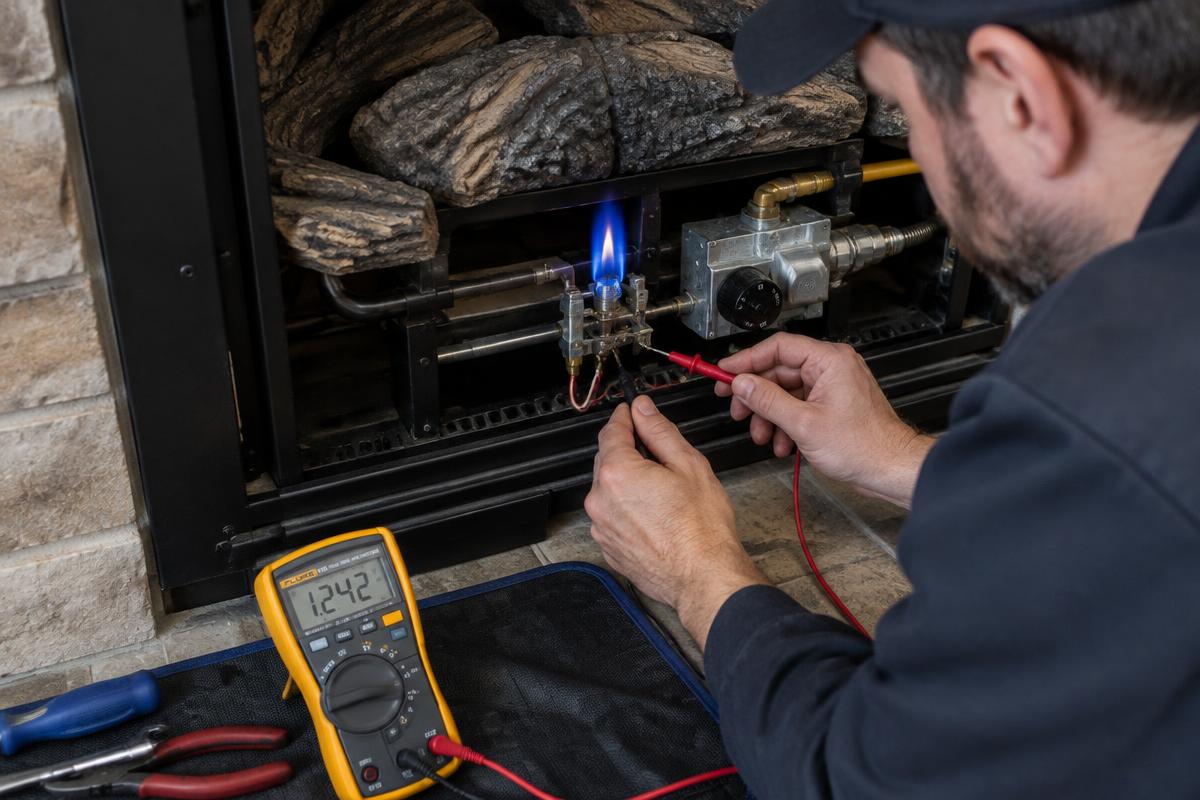
Next, we conduct precise diagnostic measurements using digital multimeters and low-pressure manometers. We test the closed and open circuit millivolt outputs from your thermopile and thermocouple to confirm they meet the manufacturer threshold required to hold the main gas valve open. We also measure manifold gas pressure to verify that incoming natural gas supply aligns with the technical rating plate inside the appliance, ruling out fuel starvation or over-firing.
Our process also evaluates the structural condition of the glass door gasket, the ceramic log placement, and the condition of the pilot hood. We check that the pilot flame engulfs the top third of the sensor probes and that the secondary air shutters are set at the correct aperture. Once diagnostics are complete, we discuss our findings plainly with you, providing straightforward solutions before starting any replacement or mechanical restoration work.
- Systematic electrical testing of thermocouples, thermopiles, and wiring
- Accurate gas pressure verification at the main control valve manifold
- Inspection of high-temperature door seals, gaskets, and viewing glass
- Detailed explanation of component health and practical recommendations
"I booked an annual chimney sweep in Unionville and they arrived right on time. They cleared all creosote, inspected the flue draft, and shared simple maintenance tips. My fireplace runs smoother and safer now."
Our process
How we handle your monessen hearth fireplace, step by step
- 1
Arrival and Setup
We arrive on schedule, place clean drop cloths across your hearth area, and review the specific operational symptoms you have observed with your Monessen fireplace.
- 2
Visual and Mechanical Diagnostics
Our technician tests electrical millivolt outputs, verifies incoming and manifold gas pressures, inspects wiring harnesses, and checks the pilot flame alignment using digital multimeters.
- 3
Precision Cleaning and Tuning
We disassemble and clean the pilot orifice, vacuum the lower cabinet and convection chambers, remove burner debris, adjust air shutters, and clean the interior viewing glass.
- 4
Repairs and Part Replacement
If damaged components are detected, we install compatible replacement parts, re-secure safety latches, reposition ceramic logs correctly, and confirm airtight glass gasket seals.
- 5
Final Burn and Safety Testing
We fire the appliance through multiple burn cycles, verify clean flame combustion and smooth ignition, and review routine maintenance guidelines with you before departure.
Targeted Mechanical Repairs and Precision Cleaning Work
Proper service of a Monessen gas fireplace extends far beyond wiping down the viewing glass. Our hands-on restoration begins with dismantling and cleaning the pilot assembly, removing microscopic carbon accumulation from the flame sensor, spark igniter, and pilot orifice. This delicate cleaning ensures rapid, quiet ignition and prevents intermittent pilot dropouts during cold spells.
We carefully lift out the ceramic log set, marking their correct positioning according to the factory footprint map, and vacuum the burner ports, air mixers, and lower cabinet cavity. Lint and pet fur frequently settle in the convection channels below the firebox, insulating the gas valve and fan motor, which causes premature component overheating. We use specialized non-abrasive soft brushes and HEPA filtration to eliminate every trace of dust without dispersing particulate into your living room.
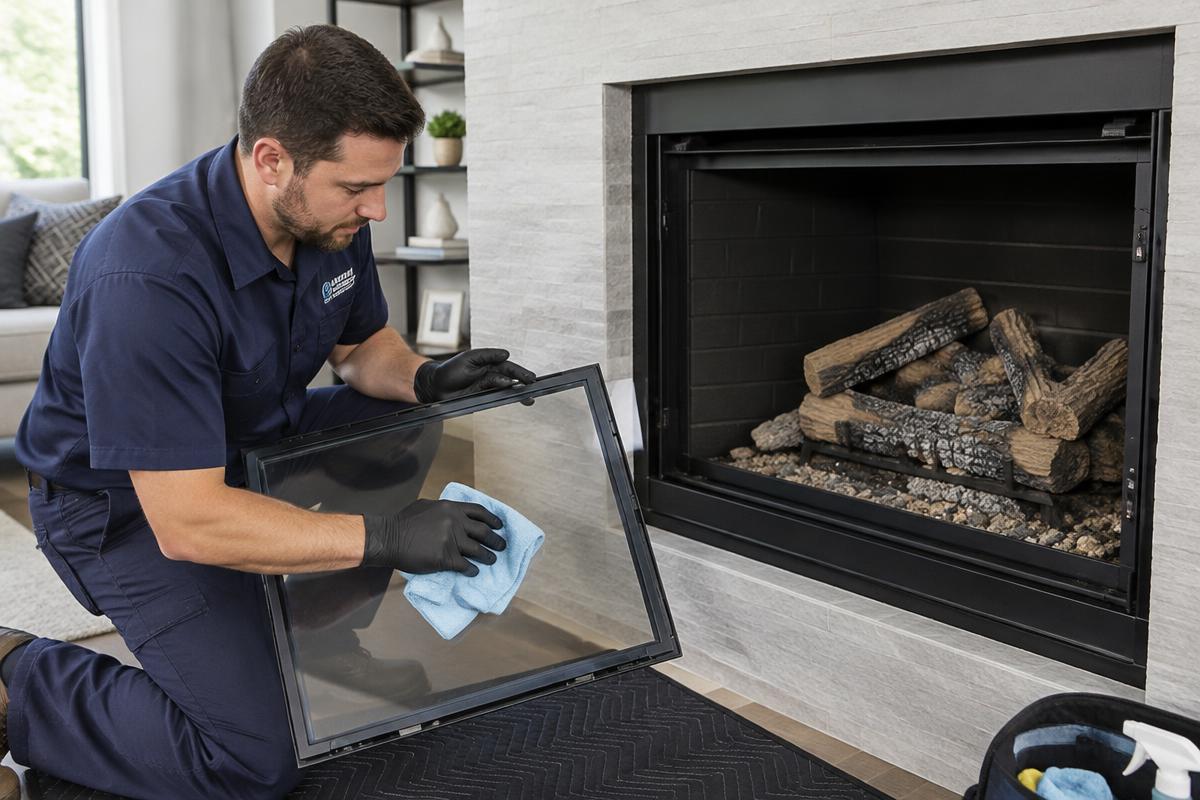
If mechanical parts have failed, we replace worn components such as remote control receivers, wall switches, blowers, and safety pilot valves with industry-compatible parts. After reassembly, we carefully clean the interior surface of the ceramic glass with dedicated gas-glass cleaner, preventing permanent mineral etching caused by sulfur combustion byproducts, and verify that the glass clamp system secures an airtight combustion seal.
- Precision cleaning of pilot burner orifices and electrical sensors
- Vacuuming lower convection cavities to protect blowers and valves
- Safe removal, inspection, and repositioning of decorative log sets
- Non-abrasive glass restoration using specialized ceramic glass cleaners
Safety Standards, Clearances, and Carbon Monoxide Prevention
Gas hearths are safe, sealed heating appliances when properly maintained, but safe operation requires strict adherence to combustion clearance and venting rules. We evaluate clearances to combustibles surrounding your mantel, hearth extension, and adjacent woodwork, referencing Canadian standard practices to verify that radiant heat does not pose a structural fire risk. In older Markham homes where renovations have altered wall construction, verifying these clearances is an essential safety precaution.
Carbon monoxide is a colourless, odourless byproduct of incomplete hydrocarbon combustion that can occur if a gas hearth suffers from improper gas-to-air mixtures or blocked flue passages. During our service visits, we verify that the venting system exhausts combustion gases safely to the building exterior. We also confirm that working carbon monoxide alarms are installed on every sleeping level of your home, as mandated by the Ontario Fire Code, and advise homeowners on ideal detector placement.
We also examine the thermal safety switches, spill switches on b-vent appliances, and the integrity of the tempered or ceramic glass assembly. Operating a gas fireplace with cracked glass or loose mounting latches can draw excess room air into the combustion zone or leak exhaust gases into living areas. We ensure every safety latch, pressure relief spring, and gasket barrier is aligned properly before signing off on our work.
- Clearance evaluations around mantels, hearth extensions, and trim
- Verification of exhaust draft integrity and sealed combustion balance
- Ontario Fire Code carbon monoxide alarm guidance and safety checks
- Glass door latch tension and relief spring mechanism inspection
Seasonal Maintenance Practices and Homeowner Care Tips
Taking proactive care of your Monessen hearth between professional service visits keeps the appliance functioning efficiently and extends the life of internal electronics. Homeowners should avoid using standard household ammonia cleaners or window sprays on fireplace glass, as these chemicals create cloudy streaks that bake permanently into the glass under intense heat. Always allow the appliance to cool completely before dusting exterior metal grills or touch surfaces.
If your Monessen unit uses a standing pilot, deciding whether to keep it lit during the summer months is a common homeowner question. Leaving the pilot on keeps the internal firebox dry and prevents spiders from spinning webs inside the burner orifice, which is especially useful in humid Markham summers. However, turning it off saves a modest amount of natural gas and reduces room heat during humid July weather. Whichever option you choose, scheduling an early autumn inspection ensures your hearth is ready before the first freeze.
Periodically check the batteries in your remote control transmitter and receiver box. Corroded alkaline batteries are one of the most common reasons why wall-mounted remote switches fail to signal the fireplace. Replace remote batteries annually each autumn, and keep the lower louvre compartment clear of storage items, magazines, or holiday decorations that could restrict cool air circulation around the control valve.
- Use only dedicated, non-ammonia ceramic glass cleaners when cool
- Replace wireless remote control batteries each autumn before winter starts
- Keep the lower valve access compartment clear of household clutter
- Schedule annual mechanical service before the arrival of sub-zero temperatures
Understanding Service Costs and Selecting the Right Technician
The cost of servicing a Monessen gas fireplace reflects the time, technical diagnosis, and specialized equipment needed to work safely on high-heat gas systems. Routine seasonal maintenance typically covers multi-point safety testing, complete pilot teardown, burner cleaning, and glass reconditioning under a straightforward flat-rate service fee. When physical components fail, such as a millivolt gas valve, thermopile, or electronic spark module, parts costs are quoted separately following diagnostic confirmation.
When choosing a fireplace service contractor in Markham, look for transparency, local accountability, and clear communication. A reliable service company should have a physical neighbourhood presence, itemize diagnostic versus repair labour, and gladly explain their findings without pressuring you into full appliance replacements. They should treat your home with care, lay down protective drop cloths, and leave your living room as clean as they found it.
Choosing an independent chimney and fireplace specialist ensures that you receive impartial evaluations focused solely on restoration and safety. Because we work every day on residential hearth systems across local Markham neighbourhoods, Markham Chimney Services understands the specific heating needs, housing styles, and climatic realities of our area. We deliver honest, experienced craftsmanship aimed at keeping your home comfortable and secure throughout every Canadian winter.
- Upfront pricing with clear diagnostic and part cost explanations
- Established physical business presence at 4418 Highway 7 East
- Independent mechanical advice focused on repair and longevity
- Respectful in-home service with protective coverings and clean work areas
Average pricing in Markham
$229 – $489
- Inspection / diagnostic
- $149 – $199
- Typical time on site
- 1 to 2 hours typical on site
- Parts and materials
- Thermocouples, thermopiles, gas valves, blower fans, and remote receivers quoted separately
- What moves the price
- Whether the issue requires standard maintenance or specialized electrical and valve replacement · Physical accessibility of the fireplace venting, direct vent termination, and cabinet cavity · Extent of carbon soot buildup and age of existing internal components
Estimated local market range, not a quote. All estimates are in Canadian dollars and exclude 13% Ontario HST. Your exact price is confirmed before any work begins.