An Ortal contemporary gas fireplace is an architectural centrepiece, combining clean lines, expansive glass viewing areas, and advanced heating engineering. When your system fails to ignite, shuts off unexpectedly, or displays inconsistent flame behaviour, you need a technical partner who understands the distinct requirements of modern direct-vent gas hearth appliances. Markham Chimney Services, operating from our central base at 4418 Highway 7 East, provides dedicated diagnosis, maintenance, and repair for your upscale gas installations. As an independent chimney and fireplace service company, we are not directly affiliated with or authorized by Ortal, which allows us to offer transparent, objective diagnostic assessments and dependable repairs tailored specifically to your home.
Living in Markham means your home heating appliances must endure drastic seasonal weather transitions, from sweltering, humid summers to deep sub-zero winter spells. These severe temperature shifts place significant stress on direct-vent seals, exterior wall termination caps, electronic control modules, and pilot assemblies. A malfunctioning gas fireplace compromises your comfort and poses real indoor air quality concerns if venting or gas supply systems falter. Our local technicians take a thorough, safety-first approach to troubleshooting your Ortal unit, systematically evaluating your burner assembly, electronic ignition, power vent systems, and glass gaskets to ensure safe, reliable warmth throughout the long Ontario winter months.
Ortal Fireplace Repair: visit summary
Ortal Fireplace Repair: glass, burners, pilots and controls cleaned and serviced, then relit and flame-checked. Serving Markham and the Greater Toronto Area (GTA). The estimated local market range is $280 – $650, not a fixed company rate. The final scope and quote are confirmed before work begins.
| Estimated market range | $280 – $650. All estimates are in Canadian dollars and exclude 13% Ontario HST. |
|---|---|
| Typical time | 1 to 3 hours typically |
| Price factors | Access difficulty and architectural enclosure style; Presence of inline or external power vent systems; Specific electronic control module and valve components required |
| Routine signs to discuss | Persistent Pilot Ignition Failure; Dense White Film on Ceramic Glass; Uncharacteristic Rumbling or Whistling; Sudden Mid-Cycle Burner Shutdowns; Sluggish or Non-Responsive Remote Controls; Faint Odours Around the Wall Enclosure |
Understanding Modern Ortal Gas Fireplace Engineering
Ortal fireplaces are celebrated for their sophisticated architectural integration, featuring frameless designs, cool wall technology, and specialized micro-mesh safety screens. Unlike conventional masonry or builder-grade gas inserts, these systems utilize precision engineered internal clearances that channel convection air around the firebox. This design keeps outer wall temperatures down, allowing delicate finishes like artwork or drywall to sit flush with the enclosure. However, these tight tolerances mean that even a slight buildup of household dust, pet hair, or minor burner displacement can disrupt the delicate airflow currents necessary for smooth combustion.
The electronic ignition modules found in these appliances are far more advanced than older standing pilot setups. Modern systems use intermittent pilot ignition or direct flame rectification to conserve energy and provide instant flame engagement through remote controls, home automation integrations, or wall switches. These digital controllers monitor millivolt signals, flame rectification currents, and safety interlocks continuously. If any parameter falls outside factory tolerances, the internal safety board locks out the gas valve to prevent unburned fuel accumulation.
Because our technicians work as an independent fireplace repair team, we approach every Ortal unit with an objective mechanical perspective. We evaluate the entire heating loop, from the main gas supply line and manifold pressure regulators to the secondary electrical wiring and ceramic burner trays. Understanding the precise relationship between intake air and fuel delivery allows us to diagnose subtle electronic and mechanical faults that general heating contractors often overlook.
- Proprietary cool wall convection air channels requiring unobstructed flow
- Sensitive flame rectification electronic ignition modules and safety lockouts
- Balanced direct-vent coaxial and co-linear pipe configurations
- Specialized decorative media including ceramic pebbles, logs, and glass crystals
Independent gas hearth diagnostics and repairs restoring your modern Ortal fireplace across Markham homes.
Self-check
Warning signs you need ortal fireplace repair
Persistent Pilot Ignition Failure
The electronic igniter clicks continuously without lighting the pilot, or the pilot flame sparks and lights momentarily before shutting down immediately due to an undetected flame rectification signal.
Dense White Film on Ceramic Glass
A cloudy or milky white haze accumulates across the inside of the viewing glass that regular wiping cannot clear, pointing to fuel combustion by-products, improper air mixing, or failing perimeter gaskets.
Uncharacteristic Rumbling or Whistling
The appliance emits loud whistling sounds through the burner ports, or low rumbling vibrations develop within the firebox, indicating restricted combustion air intake, dirty burner ports, or misaligned gas orifices.
Sudden Mid-Cycle Burner Shutdowns
The fireplace ignites cleanly but shuts down without warning after fifteen to twenty minutes of operation, frequently caused by overheating gas valve solenoids, failing pressure switches, or weak electrical continuity.
Sluggish or Non-Responsive Remote Controls
The handheld remote transmitter fails to communicate with the receiver module, resulting in erratic temperature regulation, delayed ignition cycles, or total unresponsiveness from your wall switches.
Faint Odours Around the Wall Enclosure
You detect traces of sulphur, unburned natural gas, or sharp exhaust fumes lingering near the wall framing or upper convection slots, demanding immediate shutdown and professional diagnostic assessment.
The Impact of Markham Winter Weather on Direct-Vent Units
The climate across Markham and the Greater Toronto Area brings intense freeze-thaw cycles that place unique physical strains on direct-vent fireplace systems. During severe winter freezes, exterior termination caps mounted on outside walls or rooftops are exposed to biting winds and ice buildup. Moisture inside exhaust gases naturally condenses as it meets frigid outdoor air. If heavy frost or icicles form across the intake or exhaust louvers, the appliance cannot draw adequate oxygen or expel combustion gases properly, resulting in pilot failure or sudden mid-cycle shutdowns.
Rapid temperature swings also cause structural building materials to expand and contract. This environmental movement can place subtle mechanical tension on long direct-vent flue runs, especially in complex installations featuring multiple elbows or horizontal offsets. Gaskets between venting sections can dry out or shift, allowing cold exterior drafts to enter the firebox. When freezing air settles inside a cold direct-vent firebox, it forms a dense thermal plug that resists initial ignition drafts, causing your fireplace to struggle or puff upon starting.
Additionally, high humidity during seasonal transitions creates condensation inside the venting pipes and around electrical terminals. Over time, moisture accumulation promotes oxidation on delicate micro-switches, flame sensors, and grounding points. Our local repair approach focuses directly on counteracting these environmental factors, ensuring that your vent terminals, gaskets, and electronic connectors remain robustly protected against harsh Canadian weather patterns year after year.
- Exterior vent termination frost and ice accumulation during sub-zero snaps
- Thermal air locks inside the flue caused by descending cold air
- Expansion and contraction of vent pipe joints from fluctuating temperatures
- Moisture condensation corroding delicate electrical connections and ground wires
Common Mechanical and Electronic Failure Points
One of the most frequent problems reported by homeowners is an intermittent or non-responsive pilot assembly. Modern Ortal units rely on a flame sensor rod that detects the presence of an active flame by conducting a microscopic electrical current through the ionized gas. If the pilot orifice becomes partially clogged with airborne lint or the sensor rod develops an invisible coat of carbon or oxidation, the control module fails to recognize the flame. As a direct result, the system automatically cuts power to the main burner valve within seconds.
Gas valve solenoid coils also face gradual wear from frequent thermal cycles. The solenoids open internal diaphragms to deliver natural gas or propane to the burner tray at carefully metered pressures. When a solenoid coil weakens, it may function correctly when the appliance is cold, only to fail after fifteen to twenty minutes of steady operation as heat builds within the lower control cavity. This issue leaves homeowners puzzled as the fireplace repeatedly turns on, burns briefly, and then shuts down without an obvious mechanical cue.
Remote receiver controls and wall-mounted touch switches represent another common failure category. Many luxury installations use battery-powered receivers tucked inside lower access compartments or nearby wall cavities. These components are susceptible to signal interference, low-voltage degradation, and heat fatigue. When communication drops between the hand-held remote transmitter and the internal receiver, your fireplace might ignore ignition commands entirely or fail to adjust flame heights smoothly.
- Oxidized flame sensor rods causing immediate pilot safety shutdowns
- Partially obstructed pilot orifices restricting initial fuel flow
- Thermally compromised gas valve solenoids causing mid-burn cutoffs
- Desynchronized remote controls and degraded receiver battery packs
Power Venting, Flue Pressures, and Airflow Dynamics
Many expansive Ortal linear fireplaces depend on inline or exterior power vent systems to safely navigate complex architectural venting paths. Power vent blowers actively draw combustion gases through horizontal runs that would otherwise lack the natural buoyant draft required by standard direct-vent appliances. Within these setups, a precision vacuum differential switch monitors internal air pressure inside the flue pipe. If the pressure switch does not detect sufficient negative pressure before ignition, the main gas valve will not open under any circumstance.
Over months of regular use, mechanical blower wheels can gather dust or experience bearing wear, reducing their rotational speed and total airflow capacity. Even a slight reduction in cubic feet per minute can prevent the vacuum switch from making electrical contact. In other instances, the small silicone sensing tubes connecting the exhaust flue to the pressure switch can become brittle, cracked, or blocked by internal condensation, resulting in an error code that halts fireplace operation.
Our diagnostic team pays close attention to these balanced pressure systems during repair visits. We inspect the physical blower assembly, test the mechanical vacuum switch using a digital manometer, and ensure all electrical interlocks communicate cleanly with the primary control module. Restoring precise balance to this forced air exhaust loop is critical for preventing sooting, preserving glass clarity, and guaranteeing long-term operational safety.
- Inline and external power vent fan motor bearing degradation
- Differential pressure switch failure or silicone sensing tube cracks
- Excessive horizontal flue runs creating backpressure issues
- Electrical relay and interlock communication dropouts
"I scheduled a full fireplace cleaning before winter. They used professional-grade tools to remove every trace of soot, tested airflow, and provided clear advice on maintenance. My hearth looks brand new and works flawlessly."

Our process
How we handle your ortal fireplace repair, step by step
- 1
Safe Access and Containment
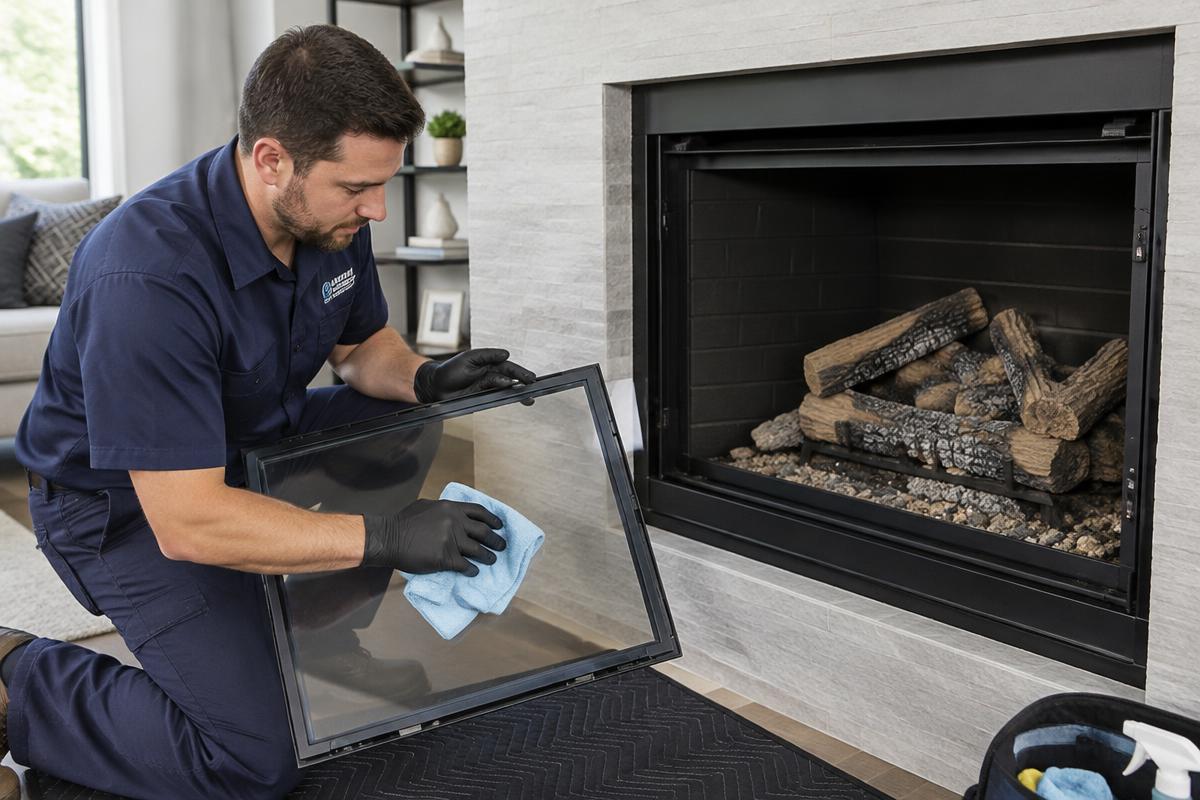
We lay protective floor coverings, disconnect electrical power and main gas supplies, and safely remove the architectural glass using specialized heavy-duty vacuum suction equipment.
- 2
Comprehensive Diagnostic Testing
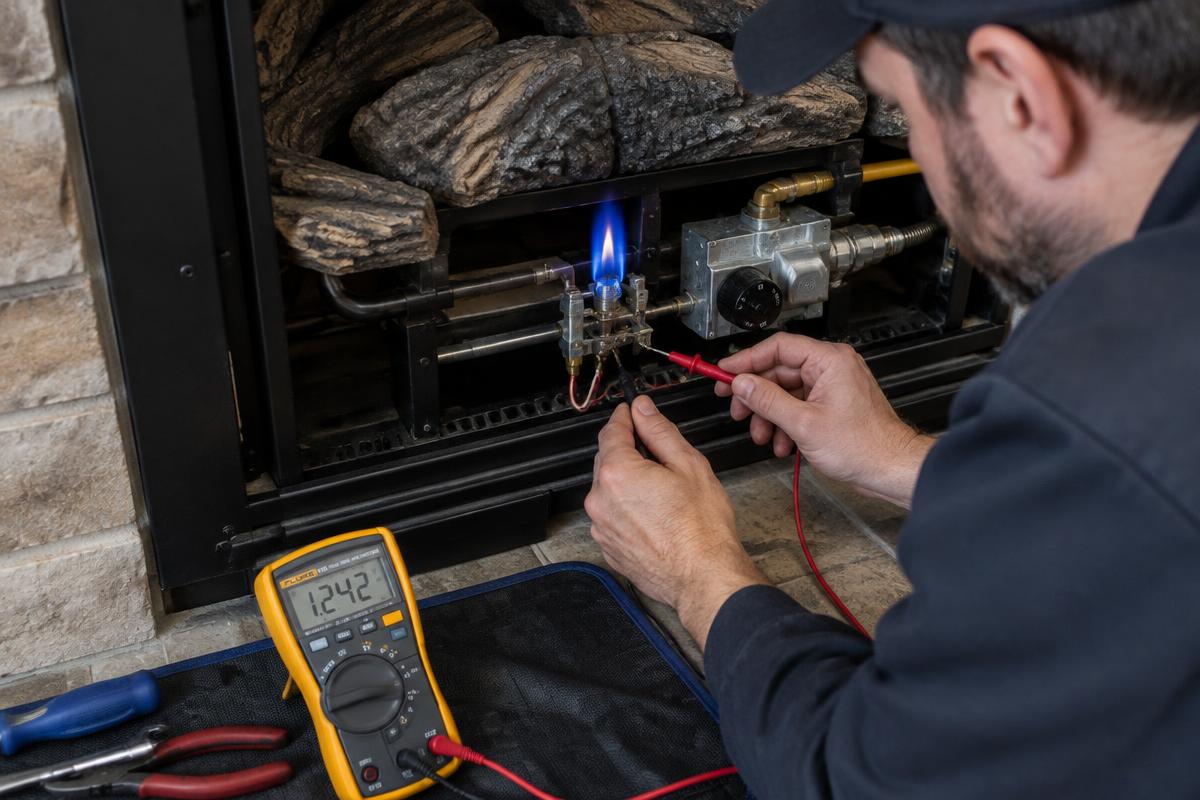
Our technicians measure gas pressures with digital manometers, test electronic circuits for voltage drops and microamp flame rectification, and inspect pilot orifices for carbon buildup.
- 3
Targeted Component Remediation
We clean or replace worn flame sensors, clear clogged pilot burners, service power vent pressure tubes, and install high-quality replacement parts tailored to your system's exact specifications.
- 4
Venting and Gasket Verification
We thoroughly examine the ceramic glass gasket, inspect exhaust termination pathways, and verify that the direct-vent air circulation loop is airtight and completely free of obstructions.
- 5
Operational Burn and Safety Clearance
We reassemble the enclosure, re-establish fuel flow, perform electronic gas leak tests, and monitor full-cycle combustion and remote controls to guarantee smooth, reliable operation.
Our Meticulous Diagnostic and Repair Process
Every repair visit begins with an attentive conversation and a methodical visual examination of your installation. We review your system's operational history, discuss any strange sounds or error codes you have noticed, and assess the physical surroundings of the fireplace enclosure. Our technicians carefully protect your hardwood flooring, carpets, and surrounding furnishings with clean drop cloths before removing the protective screens and architectural glass panels using specialized suction cups designed for heavy ceramic glass.
Once internal access is secured, we deploy accurate electronic testing tools rather than relying on guesswork. We measure inlet and manifold gas pressures using high-precision digital manometers, confirming that your home's gas supply matches the exact requirements of your appliance. We test electrical circuits for proper voltage supply, inspect grounding continuity, and verify flame rectification microamp readings across the sensor assembly. We also check the pilot tubing, main burner orifices, and ignition electrode gaps against recommended operational standards.
Following our diagnostic assessment, we explain our findings in plain language and provide a clear repair plan before proceeding with any work. Whether your unit needs meticulous component cleaning, sensor realignments, gas valve replacements, or venting adjustments, we complete every repair using quality replacement parts that match system specifications. Once repairs are finished, we conduct extensive burn tests, monitoring the flame pattern and checking every joint with an electronic gas leak detector to ensure absolute safety.
- Safe extraction of heavy architectural ceramic glass using suction tools
- Precision digital manometer testing of incoming and manifold gas pressures
- Microamp electrical verification of flame rectification and safety circuits
- Post-repair combustion testing and electronic gas leak verification
Crucial Hearth Safety: Carbon Monoxide and Gas Line Integrity
Gas hearth appliances provide clean, comfortable heat when operating correctly, but any fuel-burning appliance demands rigorous respect for safety. Natural gas combustion produces water vapour, carbon dioxide, and small quantities of carbon monoxide. In a healthy direct-vent system, these exhaust gases are sealed away from your indoor living spaces by high-temperature gaskets and tempered or ceramic glass panels, discharging safely outdoors through dedicated flues.
If a glass gasket deteriorates, a retaining clamp loosens, or venting joints pull apart behind the wall, combustion by-products can leak into your home. Carbon monoxide is a colourless, odourless, and tasteless gas that can cause severe headaches, nausea, dizziness, and long-term health risks upon prolonged exposure. During every service visit, we inspect the entire perimeter of your glass assembly, checking gasket elasticity and testing for micro-leaks using sensitive ambient and sniff-probe gas detection equipment.
We also encourage every homeowner to uphold practical home safety standards by maintaining working carbon monoxide alarms on every level of the home, particularly near sleeping quarters. Our independent technicians adhere strictly to CSA-style best practices and standard hearth safety protocols during every inspection. We will never compromise on safety, ensuring that your gas shutoff valves, emergency pilot cutoffs, and exhaust seals meet the highest benchmarks before leaving your property.
- Comprehensive ceramic glass perimeter gasket inspections
- Electronic combustible gas leak detection on all internal fittings
- Verification of room carbon monoxide alarms and sensor positioning
- Adherence to Canadian gas appliance safety protocols and clearances

Homeowner Maintenance and Preventative Care Practices
While complex diagnostic and mechanical repairs must always be handled by a qualified technician, Markham homeowners can take several simple steps between service calls to keep their Ortal fireplace looking and performing at its best. The most critical homeowner task is maintaining a clean perimeter around the lower air intake and upper convection louvers. Vacuuming these openings with a soft brush attachment prevents household dust, pet dander, and rug fibers from entering the burner chamber and causing unpleasant burning odours upon startup.
Caring for the viewing glass also requires specific attention. Over months of operation, a light white film naturally forms on the inside surface of the ceramic glass as a byproduct of fuel combustion and mineral outgassing. Never clean this glass while the unit is warm, and never use common ammonia-based window cleaners, which can permanently bake chemicals into the ceramic surface. Use only non-abrasive, specialized gas fireplace glass cleaners, and wipe gently using a microfiber cloth to maintain a crystal-clear flame view.
Finally, pay attention to the seasonal battery requirements of your remote system. If your remote transmitter or receiver uses standard alkaline batteries, replace them every autumn before the heating season begins. Weak batteries produce subtle voltage drops that often cause erratic remote communication, leading homeowners to believe their main electronic control board has failed when a fresh set of batteries would resolve the issue completely.
- Regular soft-brush vacuuming of intake louvers and convection openings
- Cleaning ceramic glass exclusively with approved non-abrasive hearth cleaners
- Annual replacement of remote control and receiver backup batteries
- Prompt scheduling of service at the first sign of abnormal flame behaviour
Selecting an Independent Hearth Professional in Markham
Modern luxury gas fireplaces are specialized heating appliances that require far more technical insight than standard furnace systems or traditional open chimneys. When searching for a service company in Markham, it is crucial to choose a team with direct, practical familiarity with electronic ignition controls, cool wall construction, and balanced direct-vent pressure systems. Generic handymen or general heating contractors often lack the specific diagnostic tools needed to address intermittent electronic lockouts without costly trial-and-error part swapping.
Always seek out an established company with a physical presence in the community, transparent pricing structures, and clear communication practices. A trustworthy contractor should be prepared to explain the underlying cause of an equipment failure, detail the scope of necessary repairs, and outline exactly what replacement parts are required before work begins. They should treat your home with total respect, protecting your property throughout the service visit and leaving your living area immaculate.
Markham Chimney Services stands out by combining deep local knowledge with dedicated technical expertise. Situated at 4418 Highway 7 East, we are embedded in the Markham community and understand the distinct architectural styles and heating demands of local properties. As an independent service company, our allegiance is solely to our customers. We provide honest assessments, dependable workmanship, and personalized care to ensure your modern gas fireplace delivers reliable beauty and comfort for years to come.
- Direct experience with contemporary balanced-flue and linear gas units
- Transparent written estimates without hidden diagnostic fees
- Complete protection of interior living spaces, flooring, and mantels
- Convenient, responsive local service based right on Highway 7
Average pricing in Markham
$280 – $650
- Inspection / diagnostic
- $140 – $190
- Typical time on site
- 1 to 3 hours typically
- Parts and materials
- Gas valves, pilot assemblies, control modules, and replacement glass quoted separately
- What moves the price
- Access difficulty and architectural enclosure style · Presence of inline or external power vent systems · Specific electronic control module and valve components required
Estimated local market range, not a quote. All estimates are in Canadian dollars and exclude 13% Ontario HST. Your exact price is confirmed before any work begins.