

Every time you run a load of laundry, fine fabric fibres escape past the built-in lint trap and enter your exhaust ductwork. Over months of routine use, this warm, combustible material settles along the interior walls of the vent pipe, narrowing the passage and trapping moisture. In Markham homes, where laundry rooms are frequently tucked into finished basements or routed through long horizontal floor joists, an unnoticed lint buildup steadily chokes airflow. What begins as damp clothing after a standard cycle can rapidly escalate into an overheated appliance, elevated utility costs, and a genuine residential fire hazard behind your drywall.
Markham Chimney Services provides thorough, non-invasive dryer lint cleaning for local property owners who want peace of mind and dependable appliance efficiency. As an independent chimney and venting company based at 4418 Highway 7 East, we apply the same exacting standards to dryer exhausts that we bring to residential flues and combustion ventilation. Whether your venting discharges through a brick foundation, a high exterior soffit, or an extended run across your basement ceiling, our technicians systematically clear compacted debris, inspect transitions, and ensure your home stays protected against heat buildup and hidden lint blockages throughout every Canadian season.
Dryer Lint Cleaning: visit summary
Dryer Lint Cleaning: lint cleared from the duct and exterior hood to cut fire risk and shorten drying times. Serving Markham and the Greater Toronto Area (GTA). The estimated local market range is $179 – $349 CAD, not a fixed company rate. The final scope and quote are confirmed before work begins.
| Estimated market range | $179 – $349 CAD. All estimates are in Canadian dollars and exclude 13% Ontario HST. |
|---|---|
| Typical time | 1 to 2 hours typical on-site service time |
| Price factors | Total length of the duct run and accessibility of exterior termination points; Installation of new rigid metal transition pipe to replace unsafe plastic hoses; Severity of lint compaction, presence of pest nesting, or multi-storey roof access |
| Routine signs to discuss | Clothes Taking Multiple Cycles to Dry; Appliance Exterior Feels Excessively Hot; Burning Smell During the Drying Cycle; Outdoor Flapper Does Not Open; Noticeable Humidity in the Laundry Room; Lint Piling Up Behind the Appliance |
What Professional Dryer Lint Cleaning Really Means
Many homeowners assume that emptying the small mesh screen inside the appliance drum after each cycle is sufficient to keep the system safe. In reality, that internal mesh only catches a portion of the loose fibres shed by tumbling textiles. The remaining fleece, cotton strands, pet hair, and laundry sheet residue bypass the basket entirely, travelling into the internal blower housing and settling deep inside the concealed exhaust ductwork behind the laundry wall.
A proper professional cleaning goes far beyond vacuuming the accessible collar directly behind the dryer cabinet. Our team addresses the entire exhaust run, from the back of the appliance through the structural framing to the outdoor discharge hood on your exterior brick or siding. Using specialized rotary agitation brushes and high-volume vacuum extraction equipment, we dislodge dense lint mats clinging to the interior pipe walls without puncturing or separating hidden duct joints within your ceilings or finished drywall cavities.
The objective is to return the internal duct diameter to its original smooth condition, ensuring unimpeded velocity for moist air leaving the machine. When the exhaust diameter is fully restored, your dryer runs cooler, cycles finish within expected timelines, and your heating components endure far less operational strain. We treat the entire vent path as an active exhaust flue, recognizing that proper airflow management protects both your major appliances and your household structure from preventable heat damage.
- Mechanical dislodging of stubborn, adhered lint deposits along the complete pipe run
- Clearing the internal lint trap cavity and lower transition connection point
- Cleaning exterior louvers, backdraft dampers, and protective rodent hoods
- Checking hidden pipe seams for air leakage or disconnected joints behind finished ceilings
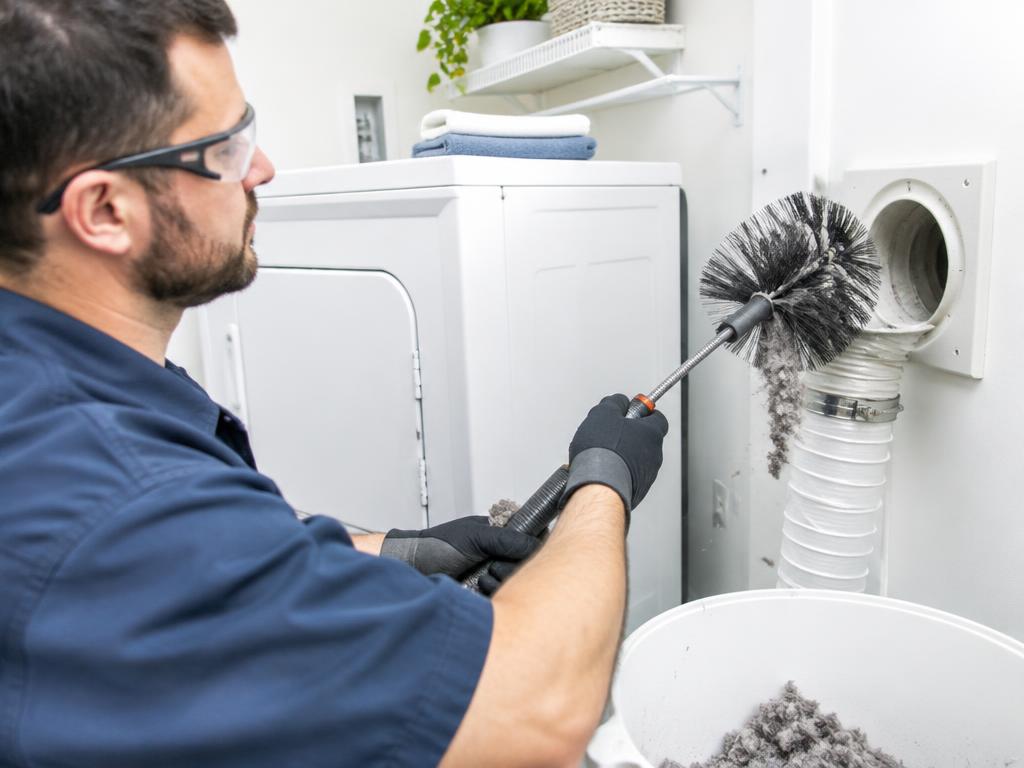
Clear out packed lint, protect your home from fire hazards, and restore your dryer performance in Markham.
Self-check
Warning signs you need dryer lint cleaning
Clothes Taking Multiple Cycles to Dry
When heavy towels or routine clothing take two or more complete cycles to dry, restricted airflow is preventing moist vapour from leaving the drum. This warning sign indicates that dense lint is trapping humid air inside the appliance.
Appliance Exterior Feels Excessively Hot
If the top or sides of your clothes dryer feel hot to the touch during operation, heat is unable to escape through the exhaust duct. This thermal buildup strains internal electronics and creates an immediate fire hazard.
Burning Smell During the Drying Cycle
A distinct burning odour in your laundry area signals that accumulated lint is making contact with the heating element or burner assembly. Turn the machine off immediately, as this indicates combustible lint is scorching inside the housing.
Outdoor Flapper Does Not Open
When your dryer is running, the exterior damper flappers should open outward with visible force. If the louvers remain resting closed or flutter weakly, your duct run is suffering from a major internal blockage or disconnected seam.
Noticeable Humidity in the Laundry Room
Warm, humid air or musty odours inside your laundry closet point to a leaking transition pipe or an occluded vent forcing moist exhaust back through cabinet joints. This moisture can quickly lead to mould growth behind drywall.
Lint Piling Up Behind the Appliance
Finding loose fabric fuzz collecting on the floor or wall behind the machine indicates a compromised transition connection, torn foil ducting, or excessive exhaust backpressure forcing lint backwards through weak joints in the line.
How Ontario Freeze-Thaw Cycles Compromise Dryer Ducts
The climate across Southern Ontario presents distinct physical challenges for residential venting systems that homeowners in milder regions never encounter. During freezing winter stretches, sub-zero exterior temperatures chill exterior walls and unconditioned basement rim joists. When your dryer pushes hot, moisture-saturated exhaust air through a cold metal duct, that warm vapour instantly condenses against the icy metal surfaces inside the pipe, transforming fine, dry lint into heavy, pasty sludge.
As repeated freeze-thaw cycles play out between November and April, this damp lint accumulation repeatedly freezes into solid crusts along the pipe perimeter. Subsequent drying cycles add fresh layers of moist fibres that freeze directly on top of the old deposits. Over several cold snaps, the open interior channel shrinks dramatically, leaving your dryer struggling to expel moist air against an icy, lint-choked restriction near the cold exterior wall or exterior discharge terminal.
Even worse, exterior vent hood louvers frequently freeze shut when condensation drips down and crystallizes in sub-zero winds. When a damper freezes shut, exhaust air has nowhere to go, forcing hot air back toward the appliance and driving damp moisture into interior wall cavities. A frozen or slush-packed exhaust vent creates immediate fire hazards and can trigger moisture damage, wood rot, and mould growth inside your exterior wall assemblies without warning.
- Rapid condensation buildup inside exhaust ducts passing through cold rim joists
- Frozen exterior flappers and discharge dampers locking shut in sub-zero temperatures
- Damp lint creating thick, concrete-like paste that clings aggressively to metal walls
- Increased risk of winter moisture leaking back into insulated perimeter framing
Primary Causes of Severe Lint Blockages in Markham Homes
While routine laundry naturally sheds fibres, severe duct blockages usually develop due to specific installation problems and ducting configurations common in local housing. Many older homes throughout Markham have undergone laundry room relocations over the decades, shifting washers and dryers from central basement utility areas into second-floor closets or converted main-floor mudrooms. These architectural changes often require exceptionally long pipe runs featuring multiple ninety-degree elbows that drastically reduce exhaust air velocity.
Every bend in an exhaust duct introduces aerodynamic resistance, causing suspended lint to drop out of the airstream and accumulate along turns. When builders or past renovators used flexible plastic ribbed hose or thin corrugated foil transitions behind walls, the problem multiplies. Those interior ridges create turbulent eddies where lint snags effortlessly. Furthermore, amateur installations frequently join metal duct sections using interior-penetrating sheet metal screws, which act as barbed hooks that catch wet lint strands and build stubborn dams.
Appliance usage habits also accelerate accumulation rates in busy family homes. Washing heavy fleece blankets, bulky towels, and pet bedding releases massive volumes of fibrous debris in short periods. Combined with high-heat drying cycles and extended vent runs running twenty feet or more to reach an outside wall, these everyday habits create prime conditions for progressive, deep-seated blockages that standard vacuum attachments simply cannot reach or resolve.
- Excessively long horizontal duct runs spanning basement ceiling joists
- Improper use of flexible corrugated vinyl or foil tubing inside wall cavities
- Sheet metal screws penetrating into the duct interior and snagging lint fibres
- Multiple sharp elbows and turns that sharply decrease exhaust air speed
Fire Hazards, Carbon Monoxide, and Laundry Room Safety
Dryer lint is exceptionally flammable, igniting quickly and burning at intense temperatures. When a duct becomes restricted by heavy lint deposits, the clothes dryer cannot vent hot air efficiently, forcing internal operating temperatures to climb beyond intended safety limits. Electric heating elements or gas burner assemblies cycle continuously under extreme heat loads, creating a direct ignition source right next to packed lint settled in the cabinet base and the exhaust collar.
For households operating gas-fired clothes dryers, a clogged exhaust line creates an additional lethal threat: carbon monoxide poisoning. Natural gas dryers generate combustion byproducts, including carbon monoxide, which must be vented entirely outside the building envelope. When lint occludes the exhaust channel, these toxic, odourless gases can spill backwards into your living areas instead of escaping outdoors, threatening the health and safety of your family.
We strongly urge every homeowner to maintain functioning carbon monoxide alarms and smoke detectors on every level of the house, especially adjacent to laundry rooms and utility spaces. Our team approaches dryer venting with the same disciplined safety mindset applied to wood-burning and gas fireplaces, adhering to rigid clearance principles and solid drafting best practices. Ensuring clean, unimpeded ventilation eliminates heat retention and guarantees that combustion byproducts safely exit your home every single time.
- Highly combustible lint deposits sitting directly beside high-temperature elements
- Restricted exhaust paths causing gas dryers to backdraft carbon monoxide indoors
- Thermal limiter switches tripping repeatedly due to dangerous internal cabinet heat
- Requirement for active, working smoke and CO alarms near all laundry installations
"I scheduled a full fireplace cleaning before winter. They used professional-grade tools to remove every trace of soot, tested airflow, and provided clear advice on maintenance. My hearth looks brand new and works flawlessly."

Our process
How we handle your dryer lint cleaning, step by step
- 1
Initial Assessment and Airflow Testing
We examine the dryer transition pipe, inspect exterior hood condition, and assess initial airflow velocity to diagnose the location and severity of lint restrictions.
- 2
Appliance Disconnection and Area Protection
We carefully pull the dryer forward, disconnect the transition pipe, and protect your surrounding flooring while establishing our negative-pressure containment collection system.
- 3
Mechanical Rotary Brush Scrubbing
We advance flexible rotary brushes through the entire duct run, scrubbing interior pipe surfaces to dislodge caked-on lint, bird nests, and compacted fibrous debris.
- 4
High-Volume Vacuum Extraction
All loosened lint and debris are simultaneously extracted using high-powered vacuum equipment, ensuring dust and allergens never escape into your home's indoor living spaces.
- 5
Reconnection, Damper Check, and Final Verification
We reconnect transitions, test mechanical seals, verify exterior damper movement, and run a complete operational check to confirm maximum exhaust velocity before finishing.
Our Professional Inspection and Lint Cleaning Workflow
Our service protocol begins with a thorough diagnostic assessment of your complete venting setup. We inspect the transition hose connecting the back of your appliance to the wall, checking for kinks, crushed sections, and unsuitable materials. We then locate the exterior discharge point on your brick, siding, or foundation to evaluate damper movement, check for exterior pest intrusion, and measure existing airflow velocity before introducing mechanical cleaning equipment.
Once our preliminary assessment is complete, we disconnect the transition pipe and establish high-powered vacuum containment at the exhaust entry. We guide specialized flexible rotary rods equipped with non-marring brush heads through the entire length of the pipe. As the rotary brush spins, it sweeps the internal perimeter clean, loosening caked-on lint mats without damaging rigid metal seams or dislodging elbows hidden inside your finished floor cavities or ceiling drywall.
After dislodging and capturing all accumulated debris, we reassemble the transition duct, confirm secure mechanical connections, and run the dryer on an air-only cycle. We return outside to measure discharge air velocity at the exterior termination, ensuring the backdraft flapper opens completely and warm air moves with unobstructed force. We conclude by reviewing our findings with you, documenting pipe condition, and outlining practical guidance to keep the system running cleanly.
- Initial static pressure and exterior airflow velocity check
- Inspection of appliance transition ducting and wall connection integrity
- Rotary mechanical brushing combined with high-volume vacuum extraction
- Damper servicing, pest screen cleaning, and final exhaust velocity verification
Proper Ducting Materials, Terminations, and Clearance Standards
A safe, durable dryer exhaust system relies on correct construction materials from the appliance connection point all the way to the outdoor hood. In accordance with established CSA building practices and municipal standards, dryer ducts should be constructed of rigid, smooth-walled metal, preferably galvanized steel or rigid aluminium. Smooth metal interior walls provide minimal resistance to outgoing air and offer no ridges or seams where drifting lint can easily catch and build up.
Flexible ribbed plastic tubing should never be installed for dryer venting under any circumstances, as it degrades over time, collapses easily, and melts quickly in high-heat situations. Semi-rigid aluminium transition ducts are acceptable only for the short, visible run between the appliance back and the wall thimble, provided they are not concealed inside wall framing or ceiling assemblies. All buried duct runs must remain rigid, with seams oriented in the direction of airflow and taped securely with heat-rated foil tape rather than cloth duct tape.
Exterior termination hoods also require close attention. Exhaust terminations should never feature standard wire mesh or coarse rodent screens, because escaping lint rapidly weaves through the wire mesh, forming an impenetrable felt blanket in a matter of weeks. Instead, exhaust outlets should feature gravity-assisted louvers or smooth backdraft flappers designed to open during operation and drop shut when the cycle ends, keeping cold Canadian drafts and curious pests safely outside.
- Use of smooth-walled rigid metal ductwork for all concealed and structural runs
- Elimination of flammable white vinyl accordion hoses and unrated transition pipes
- Sealing all duct seams with high-temperature aluminium foil tape instead of screws
- Louvered exterior caps without fine mesh screens that inevitably trap lint fibres

Practical Maintenance Habits for Markham Homeowners
While deep internal duct cleanings require specialized mechanical brushes and vacuum extraction, consistent day-to-day habits can significantly reduce the volume of lint entering your exhaust system. Make it an unbreakable rule to clean your dryer's mesh lint screen before or after every single load. A clean screen traps maximum fibres before they have an opportunity to slip past the perimeter gasket and enter the blower housing or the wall exhaust line.
Periodically wash your removable lint screen in warm, soapy water with a soft nylon brush. Over time, waxy residues from liquid fabric softeners and dryer sheets coat the fine mesh with an invisible, waterproof film that impedes air movement even when no visible lint is present. Allowing the screen to dry fully before placing it back inside ensures clean airflow through the cabinet, reducing backpressure that forces stray fibres into internal machine compartments.
During the winter months, make a quick monthly habit of inspecting your outdoor vent hood when walking around your property. Ensure that drifting snowbanks, piled garden mulch, or blowing leaves do not cover the discharge opening. Gently clear away frost crusts or icicles that might prevent the exterior flapper from swinging open freely, ensuring your laundry system maintains its designed ventilation path uninterrupted throughout freezing Ontario winters.
- Clean the appliance lint screen before starting every individual drying cycle
- Wash the mesh screen quarterly to remove invisible fabric softener wax films
- Keep the floor and wall area behind your dryer vacuumed and free of dust bunnies
- Check outside vent hoods monthly during winter to ensure dampers are free of ice
Choosing a Dedicated Venting Professional in Your Area
Selecting the right contractor to clean your dryer exhaust requires looking beyond simple carpet cleaning companies that treat vent maintenance as an afterthought. Because clothes dryers are high-temperature heat-producing appliances that vent directly through residential structural framing, the technician servicing your system must understand airflow dynamics, backdrafting risks, and combustion venting safety. Flue specialists bring a unique, disciplined perspective to duct clearing that generalist handymen often miss.
When speaking with potential service providers serving Markham and the Greater Toronto Area (GTA), ask specific questions about the equipment they employ. A contractor who simply hooks an ordinary shop vacuum to the outdoor hood cannot dislodge compacted, sticky lint mats wrapped around internal ninety-degree elbows deep within floor cavities. Effective cleaning demands mechanical rotary brushing paired with negative-pressure containment to ensure loosened debris is extracted rather than packed tighter.
Additionally, ensure your service provider inspects the transition ducting, checks for proper rigid pipe construction, and tests damper operation before leaving. An honest, independent venting specialist will clearly explain any physical deficiencies in your vent layout, such as excessive run lengths or crushed flex duct, and provide straightforward recommendations to bring your installation up to modern safety expectations without pushing unnecessary hardware or high-pressure add-ons.
- Select technicians trained in combustion venting principles and chimney flues
- Verify they utilize rotary brushing gear rather than simple handheld vacuums alone
- Insist on an inspection of the exterior hood, flappers, and internal transition pipe
- Work with transparent, local independent specialists rooted in your community
Average pricing in Markham
$179 – $349 CAD
- Inspection / diagnostic
- $89 – $129 CAD (applied toward service upon approval)
- Typical time on site
- 1 to 2 hours typical on-site service time
- Parts and materials
- Rigid aluminium transitions, worm-gear clamps, foil tape, and exterior louvered vent hoods quoted separately if required
- What moves the price
- Total length of the duct run and accessibility of exterior termination points · Installation of new rigid metal transition pipe to replace unsafe plastic hoses · Severity of lint compaction, presence of pest nesting, or multi-storey roof access
Estimated local market range, not a quote. All estimates are in Canadian dollars and exclude 13% Ontario HST. Your exact price is confirmed before any work begins.